 ChickenRoad
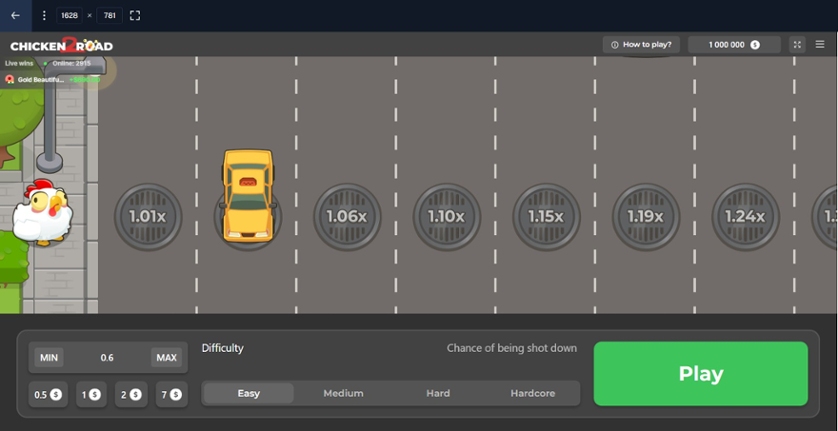
Approach 1: a fixed multiplier
You choose a target multiplier in advance, for example ×1.5, and cash out as soon as it is reached. The decision is made before the round starts, so emotions have little influence.
The advantage is frequent small payouts. The downside: with a high target, wins are rarer, and a run of losses can drain the balance quickly. It suits players who play short sessions and plan their budget in advance.
Approach 2: a fixed number of steps
Instead of a multiplier, you limit the number of lanes crossed, for example three steps on Medium. It is convenient if you often change difficulty, since one rule applies to all levels.
The weak point: on harder levels three steps give a higher multiplier and a higher risk. So it is better to tie the rule to the level, not only to the number of steps.
Approach 3: a time and money limit
This approach concerns the whole session rather than a single round. You set the amount you are ready to lose and the time you will play, and you stop when either limit is reached. It doesn't change the game's maths, but it protects you from long losing streaks and impulsive decisions.
What to keep in mind
- Keep the bet per round to a small share of the session budget, for example 1–2%.
- Progressions such as doubling after a loss quickly hit the table limit or the bankroll.
- Test any tactic in demo mode before playing for money.
- Write your results down: without records it is hard to tell whether you followed your rules.
Try Chicken Road without risk
Demo mode, virtual balance, no registration.
Questions and answers
Is there a strategy that always wins?
No. Each step is independent, and the casino's edge is built into the RTP. Strategies change how results are spread out, not the expected return.
Which approach is best for a beginner?
Usually a fixed multiplier or a time and money limit, because the rules are simple and decided in advance.
Why not just double the bet after a loss?
A losing streak can be long, while the table limit and your bankroll are finite. One bad run can wipe out the whole balance.